Beds, Bathrooms and Shared Space: Choosing Group Accommodation in Kingscliff
A House Can Sleep 10 Without Suiting Every Group of 10
A holiday home advertised for 10 guests gives you one useful figure: its maximum guest capacity. It does not tell you whether three couples will have suitable bedrooms, whether teenagers will be comfortable sharing bunks, or whether everyone can sit around the dining table together.
For group accommodation in Kingscliff, start with the people travelling and work backwards.
A group of 10 could be two families with young children, five couples, grandparents travelling with adult children, or a group of friends. The headcount is the same, but the accommodation requirements can be very different.
Bedrooms, bathrooms, bedding configurations and shared spaces all affect how comfortably a property works once everyone arrives.
Start With People Before Counting Bedrooms
Before comparing large holiday homes in Kingscliff, write down exactly who is staying.
Turn Your Guest List Into Sleeping Groups
Separate your guests into practical sleeping groups. For example, you may have three couples, two children who can share and two individual adults who each need their own bed.
That gives you a clearer picture than the guest count alone.
Identify which guests need private rooms, who is comfortable sharing and which bedding arrangements may not work.
Age matters too. Two young siblings may be comfortable sharing a bunk room. Two adult friends may prefer separate single beds. A couple travelling with an infant may want enough bedroom space for a cot. Grandparents may prefer a quieter room away from children’s sleeping areas.
Work out these requirements before browsing properties and you can rule out unsuitable layouts more quickly.
Decide Who Can Comfortably Share
An available bed does not automatically make the sleeping arrangement suitable.
Confirm expectations before booking rather than discovering on arrival that someone expected a private room.
For larger groups, record three things for each guest:
- who they can share a room with
- what type of bed they need
- whether they require their own bedroom
This gives you a realistic bedroom target before you start comparing properties.
Count Bedrooms Around Privacy and Bedding
The headline bedroom number only tells part of the story. You also need to look at the actual configuration.
A four-bedroom property might contain three queen bedrooms and a bunk room. Another four-bedroom home could have two queen rooms plus bedrooms fitted with single beds. Both have four bedrooms, but they suit different types of groups.
Start by allocating the private bedrooms.
Couples will generally occupy one room each. Solo adults may need separate rooms or separate beds depending on the group. Children can often use twin or bunk configurations, provided the arrangement suits their ages and their parents’ preferences.
Instead of asking, “Does it sleep 10?”, ask, “Can these 10 people sleep here in the arrangement we need?”
That makes the search much more precise.
| Group detail | What to check |
| Couples | Enough suitable private rooms |
| Solo adults | Separate beds or private rooms where needed |
| Children | Age-appropriate twin or bunk arrangements |
| Infants | Enough bedroom space for a cot if required |
| Older guests | Quieter rooms and practical access where relevant |
Bathrooms Can Set the Pace for the Whole Group
Bedrooms often receive the most attention during accommodation planning, but bathrooms deserve their own calculation.
Picture eight or ten people getting ready for breakfast, a day at the beach or an evening booking at roughly the same time. A property can provide enough beds for everybody while the bathroom arrangement still creates queues.
There is no single bathroom-to-guest ratio that suits every holiday. Your group composition gives you a better guide.
Several couples may value more privacy. Families with young children can have overlapping bath and shower routines. Teenagers may increase bathroom demand. Multi-generational groups may benefit from easy access and fewer people sharing the same facilities.
Look at the bathroom configuration as well as the total number.
Ensuite Bedrooms Can Solve More Than One Problem
An ensuite can provide privacy and reduce pressure on the main bathroom at the same time.
For an extended family holiday, an ensuite may suit grandparents or one family unit particularly well. For a group of couples, it can also help distribute bathroom access more evenly.
Do not simply count bathroom doors. Check which bedrooms have direct access, which facilities are shared and whether separate toilets are available.
The layout often tells you more than the total.
Shared Space Decides How the House Feels During the Day
Sleeping arrangements solve the night-time part of a group holiday. Most waking hours are spent elsewhere.
A large group needs enough usable communal space to gather comfortably.
Check the dining area first. If everyone plans to eat together, can the available seating accommodate the full group? Then look at the main lounge and outdoor entertaining areas. A property that sleeps 10 can still feel tight if only six or seven people can comfortably sit together.
The kitchen deserves similar attention. Group holidays often involve shared breakfasts, snacks, drinks and meals, even when local dining is part of the plan. Bench space, food storage and the overall kitchen layout can affect how easily several people use the room.
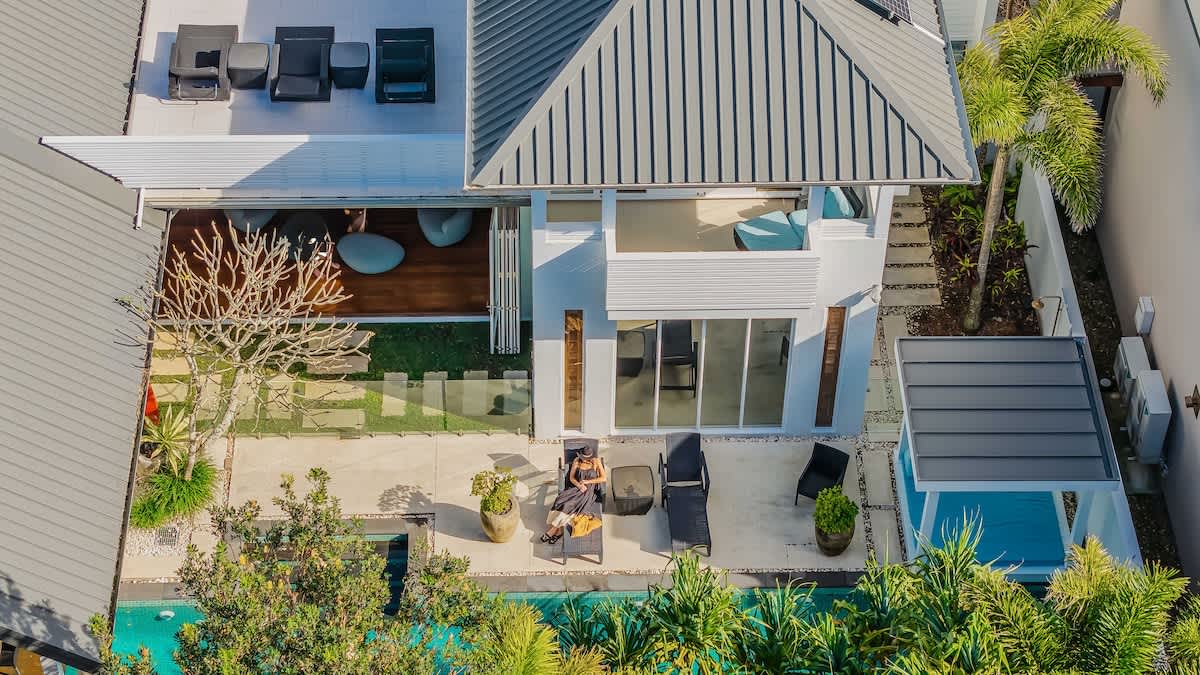
Outdoor areas can also give the group more usable space. A deck, courtyard, barbecue area or poolside setting may provide another place to gather, depending on the property.
Give Your Group Room to Separate
Groups usually book one house because they want to spend time together. That does not mean everyone will want to do the same thing all day.
A second living area, media room or separate outdoor zone can give guests somewhere to go without retreating to a bedroom.
Families may find this especially useful. Children might watch a film in one room while adults talk elsewhere. Teenagers can have their own space. Someone who wants an early night does not have to compete with a group still using the main living area.
Shared space brings people together. Separate space gives different routines room to coexist.
Match the Layout to the People Travelling
Different groups place pressure on different parts of a holiday home.
Extended families may need a mix of adult and children’s bedrooms, convenient bathroom access and quieter rooms for grandparents. Families travelling together may value bunk rooms and separate living areas, while groups of adult friends often need more individual beds and privacy.
Group travel represents a substantial part of Australia’s domestic tourism market. Tourism Research Australia recorded 6.9 million domestic overnight trips by family groups and 5.5 million by friends or relatives travelling together in the March quarter of 2026. Holidays accounted for 57% of family-group trips and 65% of trips taken by friends or relatives travelling together.
Room quality matters too.
A property may technically fit everyone but still leave one couple with an ensuite and another in a room better suited to children. The capacity may work while the allocation feels uneven.
Before booking, check not only whether everyone fits, but whether the bedroom and bathroom arrangement feels workable for the people travelling.
A Simple Capacity Check for Group Accommodation in Kingscliff
Before choosing a property, create a short group brief.
Record:
- total adults and children
- number of couples
- number of solo adults
- children’s ages
- private bedrooms required
- guests comfortable sharing rooms
- preferred bed configurations
- bathroom and ensuite preferences
- dining and lounge seating needed
- separate living-space requirements
- outdoor-space priorities
- parking requirements
Then compare each property against that brief.
You may find that a property with a higher advertised capacity is less suitable than a slightly smaller home with a better configuration. The best match is the home that suits the way your group plans to sleep, gather and spend time.
Tell Us How Your Group Plans to Stay
Choosing group accommodation in Kingscliff becomes easier once we know more than the total guest number.
If you are organising an extended-family holiday, a trip with friends or several families travelling together, include the number of adults and children, how many couples are travelling and what sleeping arrangements you prefer.
It also helps to mention any requirements around bathrooms, separate living areas, pools, outdoor entertaining or parking.
With those details, it is easier to narrow the search towards large holiday homes that better suit the way your group intends to use the space.
Questions That Can Save You From Choosing the Wrong Layout
How many bedrooms do we need for a group holiday in Kingscliff?
Start with the number of private sleeping groups rather than dividing your total guest number by two. Count couples, solo adults who need their own room and children who can comfortably share. Then compare that requirement with the actual bedding configuration of each property.
How many bathrooms should a large group have?
There is no universal number because the answer depends on the people travelling. Look at the number of bathrooms, separate toilets and ensuites together, then consider how the group is likely to use them during busy periods.
Should we choose a holiday home based on maximum guest capacity?
Maximum occupancy is useful for narrowing the search, but the floor plan and bedding configuration need closer attention. A home may accommodate your total number while still providing the wrong combination of bedrooms, beds or bathrooms.
Are bunk rooms suitable for group accommodation?
Bunk rooms can work well for siblings and children travelling with other families. Adult groups may prefer individual conventional beds and greater privacy. Check who will actually use the room before counting every available bunk towards comfortable capacity.
Which shared spaces should we compare?
Look at the dining area, main lounge, kitchen, outdoor entertaining spaces and any additional living rooms. Check whether the whole group can gather comfortably and whether there are alternative spaces if people want to do different things.
Does a second living area make a difference for larger groups?
It can make a property easier to share. Separate living areas allow children, adults and guests with different routines to use the house at the same time without everybody competing for one communal room.
What should we include in a group accommodation enquiry?
Include your total number of adults and children, the number of couples, preferred bed arrangements and any privacy requirements. Add the features that will shape your stay, such as bathroom preferences, separate living areas, pool facilities, outdoor entertaining or parking.
The more specific the enquiry, the easier it is to identify which property layouts deserve your attention.